Massive Flash Flood from Tibet Devastates Rasuwagadhi Border
26 Aug 2026•3 minutes read
Share


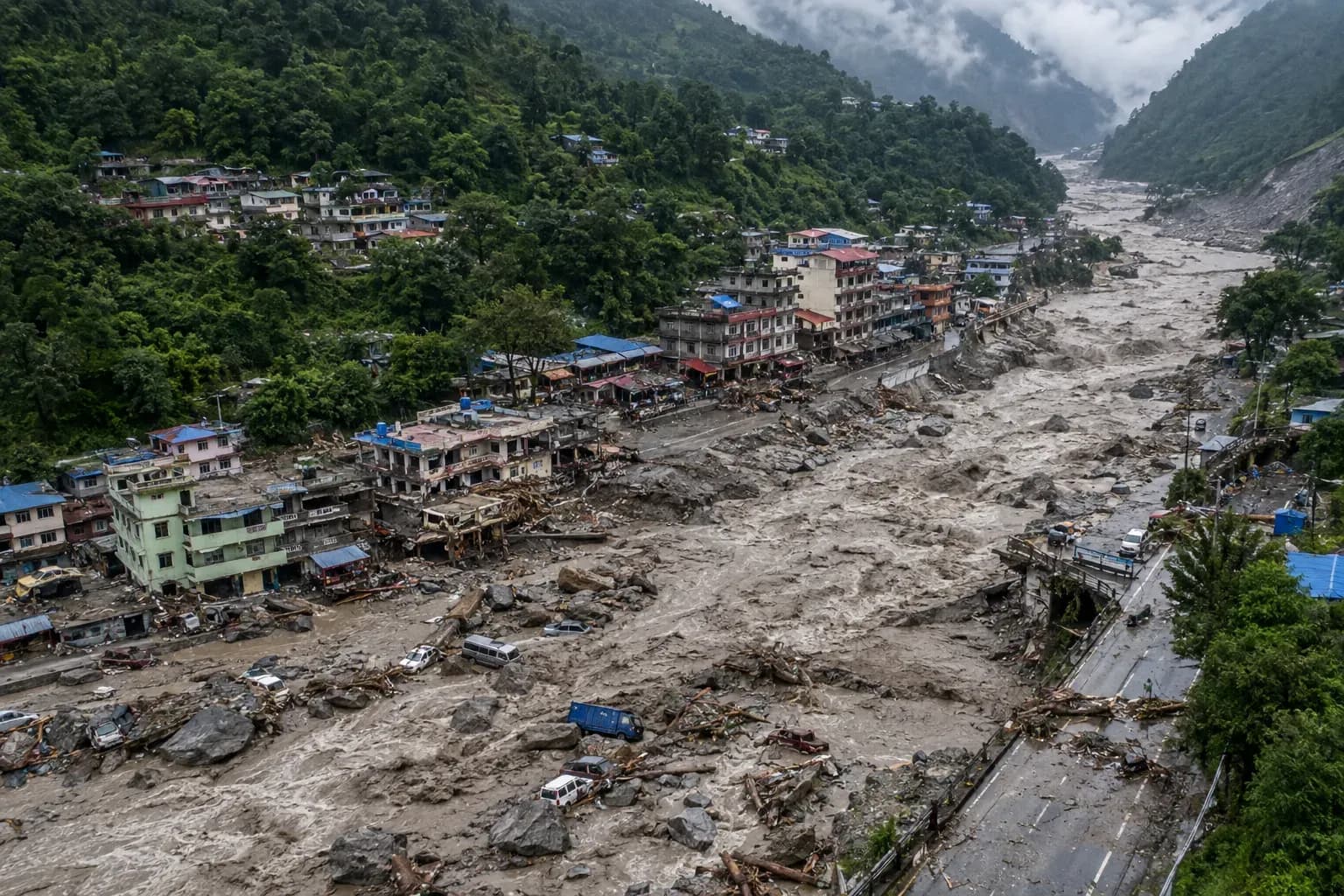
A sudden and major flash flood from Tibet hit northern Nepal’s Rasuwa district on August 26, 2026, Wednesday morning. It has already caused severe damage to local settlements, hydropower facilities, and cross-border trade infrastructure. According to reports, the flood entered Nepal through the Lhende Khola around 9:15 AM and quickly surged into the Bhote Khosi and upper Trishuli river corridors.
Witnesses and local officials said waves up to 10 meters high swept through the narrow mountain gorges. The National Disaster Risk Reduction and Management Authority (NDRRMA) quickly activated emergency response protocols under direct orders from Prime Minister Balendra Shah.
The Geography and Timeline of the Surge
The disaster began in Tibet's high-altitude upper catchment basins, where a sudden geological or hydrological event sent a large volume of water into the Lende River. Because there was no heavy rainfall on the Nepalese side of the border on Wednesday morning, local communities and border outposts had no warning of the approaching disaster.
After crossing the border at 9:15 AM, the main wave hit the Rasuwagadhi border crossing. By midday, the flood had moved downstream into Nuwakot district, passing through the Galchhi area of Dhading district. Hydrologists say the debris-filled water will continue toward the Marshyangdi confluence at Muglin before draining into the larger Narayani River system. The steep upper Trishuli basin acted as a natural funnel, increasing the speed and force of the water.
Human Toll and Widespread Destruction at Ground Zero
The damage at the border is severe. Timure Market and the main Syabrubesi settlement have been heavily damaged. Key frontline infrastructure was badly affected, including the Timure Area Police Office, the Rasuwagadhi Police Post, and the Syabrubesi Police Post, all of which suffered serious structural damage.
At the time of reporting, at least 18 individuals are officially reported missing or out of contact near the border. This includes three Nepal Police officers, local transport workers, six Nepalese laborers, and four Chinese nationals. Additionally, between 30 and 40 container drivers are currently cut off near the customs yards due to collapsed roads and lost communication networks. Downstream, low-lying riverside towns in the Uttargaya Rural Municipality, including Betrawati, Mailung, Salletar, Shantibazar, Pairebesi, Khalti Basti, Sole, Trishuli, and Battar, face immediate evacuation orders due to rising river levels.
The flood hit during trekking season, leaving dozens of international tourists and Nepalese guides stranded along the Tamang Heritage Trail and at the main entry points to Langtang National Park. Broken bridges and landslides have trapped several hiking groups in high-risk areas. We will update as the fresh information keeps on being confirmed.
Update:
According to the Rasuwagadhi Customs Office, a sudden flood in the Bhotekoshi River may have swept away about 500 vehicles parked on both sides of the customs area.
The Nepal Trans-Himalayan Border Commerce Association said about 200 containers in the Timure customs yard were washed away, and nearly 300 containers heading to China were also caught in the flood. The flood also caused heavy damage to customs infrastructure. Authorities are still assessing the total damage, as many customs employees fled the area, leaving behind their phones and belongings.
Government Actions in the midst of Disaster
The government has dispatched two Nepali Army helicopters for search and rescue. An emergency meeting is underway at the Home Ministry. Prime Minister Balendra Shah has also called a meeting to discuss the flooding and the government's response. Authorities have urged people along the Trishuli River to move to safer areas as the flood moves downstream.
The government has also deployed the Nepali Army, Armed Police Force and Nepal Police for rescue and relief work, with more personnel coming from other districts, Shah said. The National Disaster Risk Reduction and Management Authority has been activated, and medical teams, Scouts and the Red Cross have been asked to help coordinate relief efforts. More ambulances and medical staff are also being deployed.
World Health Organization announces Health and Relief Packages
The World Health Organization is preparing to send health and relief supplies to people affected by flooding in Rasuwa's Bhotekoshi River. The Health Ministry said WHO decided to provide basic medicines and health equipment for 1,000 people after talks with Health and Food Safety Minister Nisha Mehta. It will also send 15 emergency tents for every 24 square meters to the affected areas.
The ministry said 100 emergency beds have been reserved at Bir Hospital and the Trauma Center in Kathmandu for flood victims. So far, three injured people have been rescued and taken to Kathmandu for treatment.
The ministry is also coordinating emergency health services with federal hospitals in Kathmandu, blood transfusion centers, the health ministries of Bagmati and Gandaki provinces, Nepal Red Cross, Lions, and Nepal Scouts.
Strategic Travel Closures and Public Advisories
The Kathmandu Valley Traffic Police and local offices have issued strict safety orders. The Prithvi Highway and the Muglin-Narayanghat road corridor are under close watch, and all non-essential traffic toward Nuwakot, Rasuwa, or the northern border has been stopped. The public is strongly advised to stay away from the Trishuli and Bhote Koshi riverbeds.
All riverbank activities, including fishing, sand mining, and transport driving near the banks, are banned until water levels return to safe levels. Local volunteer groups, including the Nepal Red Cross and Nepal Scouts, have been deployed to downstream areas to help with emergency alerts and temporary shelters.
Nepal Tourism Board Announcement
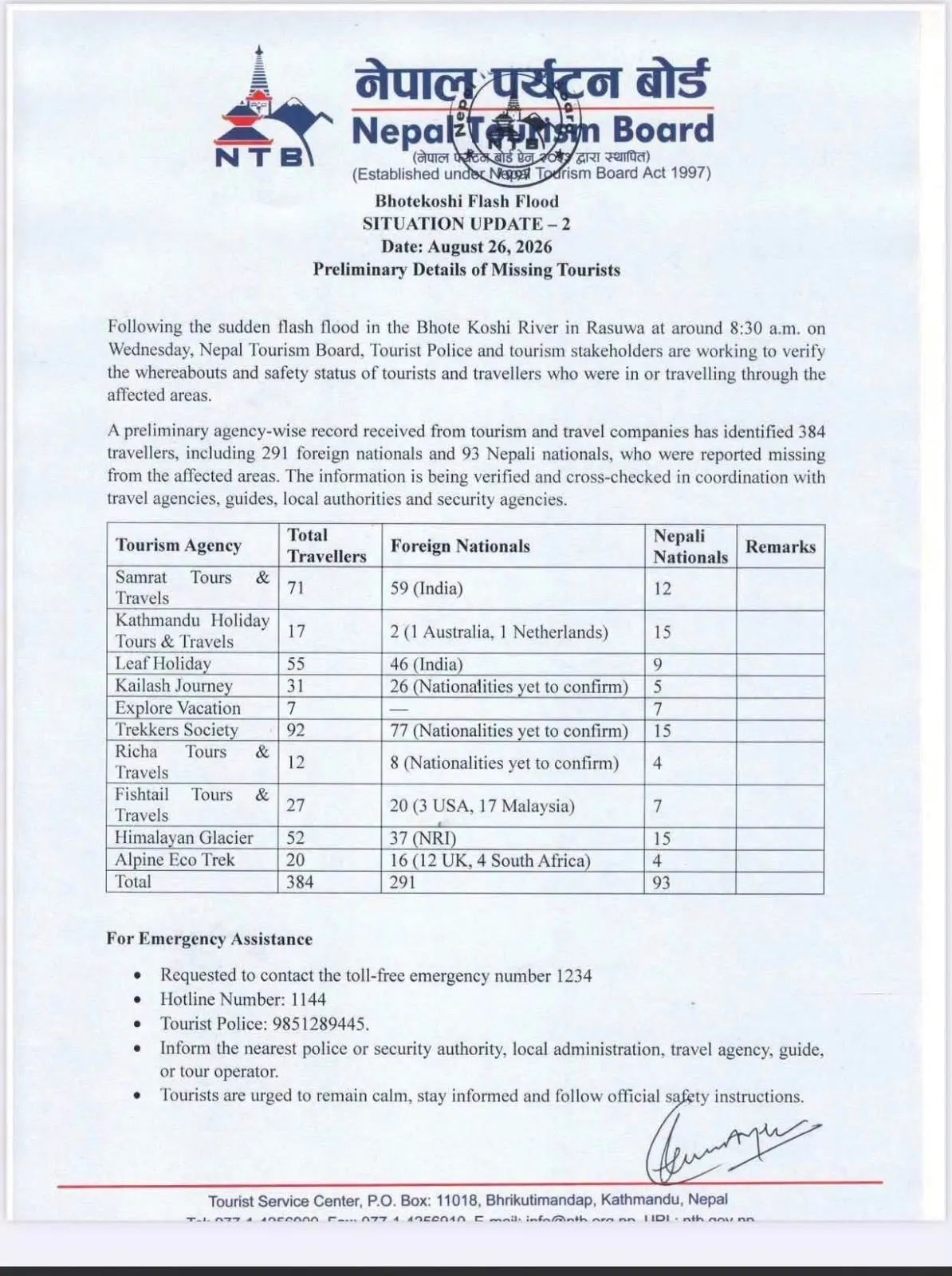
According to Nepal Tourism Board Situation Update-2, the preliminary agency-wise record identified 384 travelers as missing, including 291 foreign nationals and 93 Nepali nationals. Nepal Tourism Board, Tourist Police, tourism stakeholders, travel agencies, guides, local authorities, and security agencies are working to verify the whereabouts and safety status of those affected.
The preliminary list includes travelers associated with several tourism and trekking agencies, with Trekkers Society reporting the highest number at 92, followed by Samrat Tours & Travels with 71 and Leaf Holiday with 55. The Tourism Board urged people requiring emergency assistance to contact 1234, the 1144 hotline, or Tourist Police at 9851289445, while advising tourists to remain calm, stay informed, and follow official safety instructions.
Emergency Helpline Numbers
1. Rasuwa: 9851277777 (CDO), 9851164422 (Ast. CDO), 9851282801 (Nepal Police), 9851272275 (APF)
2. Nuwakot: 9851147777 (CDO), 9851248777 (Ast. CDO), 9851282811 (Nepal Police), 9851272535 (APF)
3. Dhading: 9851247777 (CDO), 9851196131 (Ast. CDO), 9851113921 (Nepal Police), 9851272491 (APF)
4. Chitwan: 9855017777 (CDO), 9855088891 (Ast. CDO), 9855090133 (Nepal Police), 9851272134 (APF)
5. Gorkha: 9856057777 (CDO), 9856057778 (Ast. CDO), 9856090255 (Nepal Police), 9851272271 (APF)
6.Tanahun: 9856067777 (CDO), 9856001111 (Ast. CDO), 9856090178 (Nepal Police), 9851272099 (APF)
7. 1234 (DEOC)
Latest Update as of 8: PM local Time
As per the updated news, the death toll due to the flash flood in Rasuwa has increased to 72 people, with bodies found in downstream districts including Chitwan, Dhading, Nuwakot, and Gorkha. The Nepal Tourism Board said 384 travelers are missing or out of contact, including 291 foreign nationals and 105 Indian tourists. At least 60 workers are still missing inside a construction tunnel at the 20 MW Langtang Khola Hydroelectric Project after floodwaters severely damaged the site.
The flood entered the Bhote Koshi River from Tibet on Wednesday morning, destroyed the Friendship Bridge at the Rasuwagadhi border crossing, and flooded parts of Timure Bazaar and the Timure Customs Office. The government has declared Rasuwa, Nuwakot, and Dhading disaster crisis zones because of damage to homes, police infrastructure, roads, and six major hydropower facilities. High-alert warnings remain in place downstream along the Trishuli River corridor to Muglin, and authorities have closed vulnerable sections of the Prithvi and Tribhuvan highways.
Real-time update as of 28th August
- Confirmed Deaths: 469 people are confirmed dead. Because the flood surged down the Bhote Koshi into the Trishuli and Narayani rivers, most bodies are being recovered downstream.
- Rescued Alive: 3,253 people have now been safely evacuated or treated.
- Missing Person: The official missing list has grown to 977 individuals.
Danger of Second Flood
Local social media pages and weather trackers are sharing an urgent warning from China’s Ministry of Water Resources and Nepal's disaster authority. A large blockage upstream on the Chinese side has created a temporary lake holding about 3 million cubic meters of debris and water. There is a high risk of another breach, with the highest risk expected in early September. Authorities are urging all residents along the Trishuli corridor to stay well away from the riverbanks.
Second Flood Alert
The second flood has officially started along the Nepal-China border as the newly formed barrier lake has begun to overflow. A massive debris dam, created by the initial glacial collapse at the confluence of the Chhochen and Purepu Tsangpo rivers, is now being overtopped by a continuous surge of water. Authorities in both nations are actively tracking the path of this fresh downstream flow.
Emergency officials emphasize that this active spill is not an outbursting flood, meaning the debris dam has not suddenly exploded or suffered a catastrophic structural breach. Because the water is spilling over the banks rather than releasing all at once, this secondary wave is relatively less dangerous than the initial, unprecedented wall of water that struck earlier. The predictable nature of this overflow grants downstream communities a critical window to react and move out of harm's way.
Despite the slower onset, the situation remains highly critical as the lake water volume is steadily increasing. The reservoir has already swelled to over 2.5 million cubic meters, with an additional 3 million cubic meters of water expected to pour into the basin over the next 48 hours. Because the rising water poses an ongoing threat of a larger structural collapse, all downstream rescue operations have been officially halted, and residents along the riverbanks have been ordered to evacuate to higher ground immediately.
We urge everyone to take great caution, and locate themselves toward a safe zone and away from the river banks.
Photo Credit: Nepal Photography
Share this post